
In brief
Working abroad and spending most of the year outside France does not, by itself, mean that you cease to be a French tax resident. If your spouse and children continue to live in France, the location of your foyer - the place where you normally live and where the centre of your family life is located - may result in France continuing to treat you as domiciled there for tax purposes.
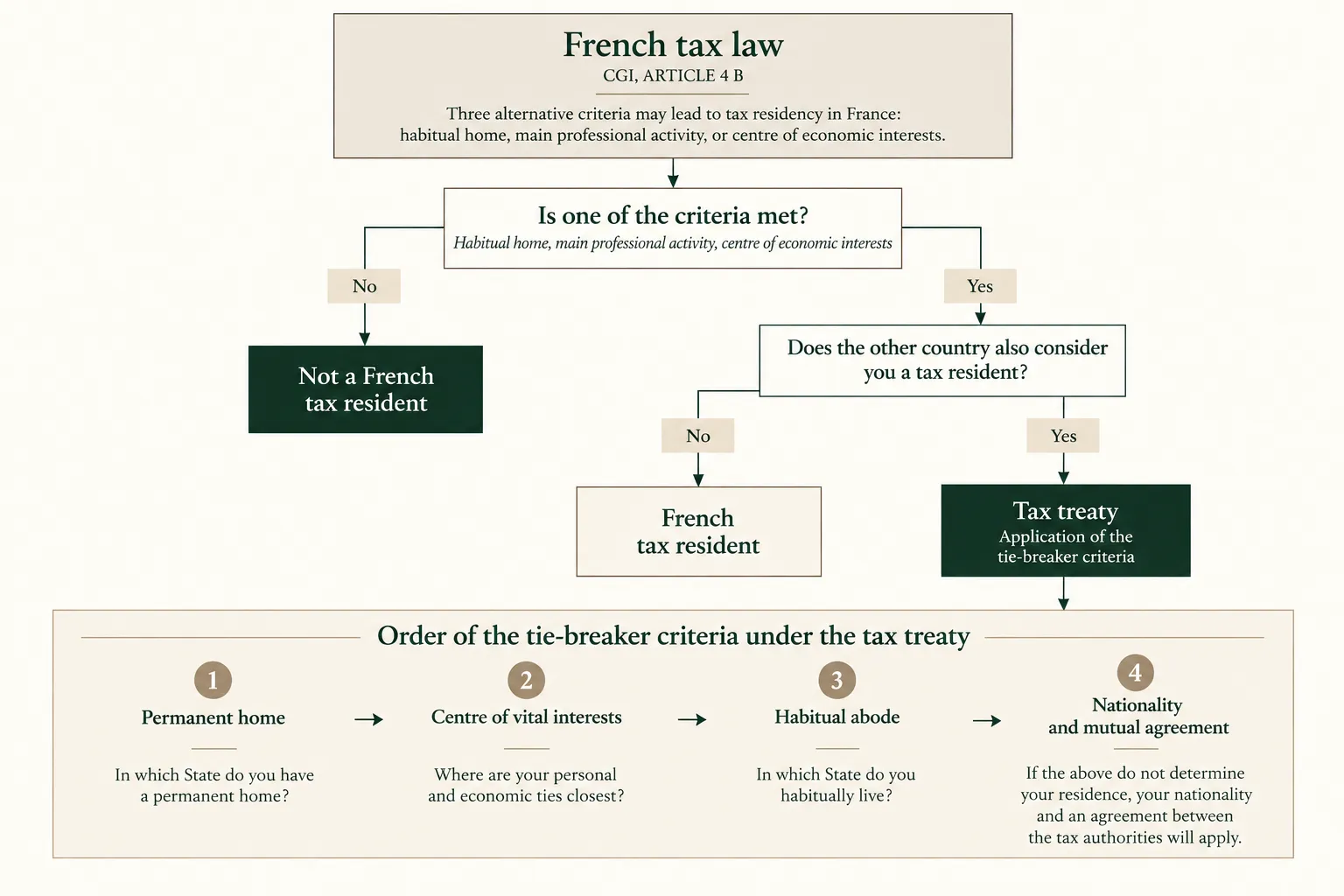
That is not necessarily the end of the analysis. If the country in which you live also considers you a tax resident, the applicable tax treaty must be examined. Since 2025, Article 4 B of the French Tax Code expressly provides that a person who meets a French domestic tax residence criterion will nevertheless not be regarded as domiciled in France where, under an applicable double tax treaty, that person is not considered a resident of France.
A move abroad is often clear-cut professionally, and far less so personally.
You may now work in London, Geneva, Dubai or New York. You have a home there, carry out your day-to-day professional activities there and spend most of the year outside France. Your spouse and children, however, have remained in France, at least initially.
Where are you tax resident in that situation?
The answer does not depend solely on your address, the country in which your salary is paid or a simple count of the days spent in France. French tax residency rules must first be considered. If both France and another country claim you as a resident, the applicable tax treaty must then be examined.
If your family remains in France, can you still become a non-resident for French tax purposes?
Yes, depending on the circumstances. However, if your spouse and children remain in France and the centre of your family life remains there, France may continue to regard you as domiciled in France for tax purposes.
Under Article 4 B of the French Tax Code (Code général des impôts), an individual may be regarded as domiciled in France for tax purposes if France is the location of their foyer or principal place of stay, the country in which they carry out their main professional activity, or the centre of their economic interests.
These are alternative tests. Under French domestic law, satisfying one of them may be sufficient.
The French concept of foyer broadly refers to the place where an individual normally lives and where the centre of their family interests is located. Spending substantial periods abroad because of professional obligations does not necessarily move that foyer outside France.
A French Conseil d’État decision of 21 October 2011 (no. 333898) provides a useful illustration. The taxpayer worked in Saudi Arabia and, for most of the period concerned, principally stayed there. However, he maintained a common home in France with his wife and returned there regularly. The Conseil d’État upheld the conclusion that his tax domicile remained in France, notably because the centre of his family interests remained there.
Spending most of his time abroad was therefore not sufficient to move his foyer outside France.
The presence of a spouse in France is not, however, decisive in every case.
In a decision of 12 March 2010 (no. 311121), the Conseil d’État considered the position of a taxpayer working in Zimbabwe whose wife remained in France. The spouses continued to manage certain common financial and property interests, including their family property. Nevertheless, the taxpayer returned to France only occasionally, his adult children no longer lived with their mother, and he had established his personal life in Zimbabwe. The Conseil d’État therefore concluded that the centre of his family interests - and consequently his foyer - was in Zimbabwe.
These decisions illustrate an important point: French tax residence cannot be determined from one connection with France in isolation. The taxpayer’s actual personal and family circumstances must be examined as a whole.
Does spending fewer than 183 days in France end your French tax residency?
No.
The 183-day rule is frequently presented as though it automatically determines whether an individual is a French tax resident. French tax law does not work that way.
The amount of time spent in France may be relevant when determining an individual’s principal place of stay. But under the personal test in Article 4 B, the principal place of stay is considered where the individual does not have a foyer.
The French tax authorities’ official guidance (BOFiP) also recognises that a family residence in France may remain an individual’s foyer even where that person stays abroad temporarily, or for most of the year, because of professional commitments.
Spending the majority of the year outside France is therefore not sufficient, by itself, to establish French non-resident status.
The 183-day threshold also appears in other areas of international taxation, including certain treaty provisions. Those rules answer different questions and should not be confused with the determination of French tax residence under Article 4 B.
What if your job and main sources of income are abroad?
They matter, but they must be considered as part of the overall circumstances.
Carrying out one’s main professional activity in France and having one’s centre of economic interests in France are separate grounds on which French domestic tax residence may arise.
French tax guidance notably looks at where the individual has their principal investments, manages their assets and derives the greater part of their income. More broadly, determining the centre of economic interests requires an examination of where the individual’s principal business affairs, professional activities, investments and main sources of income are located.
For an entrepreneur or executive who has moved abroad, merely incorporating or operating a foreign company does not, by itself, move their personal tax residence outside France. Conversely, retaining property or investments in France does not necessarily mean that the centre of economic interests remains in France.
The relevant question is factual: where is the individual’s economic life actually centred?
What happens if France and another country both consider you a tax resident?
This is where French domestic law alone may no longer provide the final answer.
An individual may meet one of the French domestic residence tests while simultaneously meeting the tax residence rules of another country. Where a double tax treaty exists between the two countries, its residence provisions — including any applicable tie-breaker rules — must then be considered.
This interaction was expressly clarified in French legislation in 2025. Since 16 February 2025, Article 4 B of the French Tax Code provides that an individual who satisfies at least one French domestic residence criterion is nevertheless not treated as domiciled in France where, under an applicable double tax treaty, that individual is not regarded as a resident of France.
France may therefore initially regard you as domiciled in France because your foyer remains there, while the applicable tax treaty may ultimately allocate your treaty residence to the other country.
Many French tax treaties resolve dual-residence situations by applying successive criteria such as a permanent home available to the individual, the centre of vital interests, habitual abode, nationality and, where necessary, a mutual agreement procedure between the relevant authorities.
The treaty concept of a permanent home should not be confused with the French domestic concept of foyer. For treaty purposes, a permanent home generally refers to a dwelling that is available to the individual on a lasting basis. A person whose spouse and children remain in France may therefore also have a permanent home available in the country to which they have moved.
Where a permanent home is available in both countries, the analysis may then move, depending on the wording of the relevant treaty, to the individual’s centre of vital interests — broadly, the country with which their personal and economic relations are closer.
The applicable treaty must always be reviewed individually. Treaty wording and the order or formulation of the relevant tests may differ.
Your spouse remains a French tax resident but you do not: how is the couple taxed?
The tax residence of each spouse must be distinguished from the rules governing the taxation of the couple.
In some circumstances, one spouse may be a French tax resident while the other is a non-resident. This does not necessarily mean that the spouses will be taxed separately in France.
Where spouses or civil partners remain subject to joint taxation and one is domiciled in France while the other is not, the BOFiP provides, subject to the applicable tax treaty, that the French taxable base includes all income of the spouse or partner who is domiciled in France and the French-source income of the spouse or partner who is not domiciled in France.
The foreign-source income of the non-resident spouse is therefore excluded from the French taxable base in this situation. The non-resident spouse is nevertheless still taken into account when determining the household’s quotient familial for French income tax purposes.
Different tax residences within a married couple therefore do not necessarily mean that all of the non-resident spouse’s foreign income becomes taxable in France, nor do they automatically require the spouses to file separately.
Separate taxation applies only where the specific conditions laid down by Article 6 of the French Tax Code are satisfied.
A practical example: foreign business, family and assets in France
Tax residence often becomes a pressing issue when a transaction makes it necessary to determine a position that had previously been left unresolved.
Consider an executive or entrepreneur who spends a substantial part of the year abroad, where they now operate their business and derive most of their income. Their spouse continues to work in France, their children remain in the French family home and the couple retains part of its assets in France.
For several years, this arrangement may create no obvious practical difficulty. The issue may suddenly become decisive when, for example, the foreign company makes its first dividend distribution: in which country is the executive tax resident for the year of the distribution, and which country is entitled to tax that income?
The answer cannot be inferred simply from the number of days spent abroad. The individual’s circumstances must be reviewed year by year: family home, periods of presence, professional activity and economic interests. If both countries claim residence, the relevant tax treaty must then be applied.
Tax residence is not settled once and for all. Changes in an individual’s family, professional or financial circumstances can lead to a different conclusion from one year to another.
What documents should you keep to support your French tax residence position?
Tax residence is not determined solely by what an individual declares their residence to be. In the event of a French tax audit, the underlying facts must be capable of being substantiated.
The relevant evidence will depend on the residence criterion at issue. For the foyer test, this may include the homes available to the individual, the spouse’s place of residence, the children’s schooling and the actual organisation of family life. For the principal-place-of-stay test, it may be necessary to reconstruct travel and periods of physical presence in each country.
Professional activity and economic interests may require an examination of employment agreements, corporate appointments, remuneration, shareholdings, companies, investments and principal sources of income.
Foreign tax returns and a foreign tax residence certificate can also be useful evidence. They do not necessarily determine the French tax treatment on their own.
These records are considerably easier to assemble at the time of an international move than several years later during a tax audit.
Why should you determine your tax residence before a significant transaction?
Tax residence directly affects the scope of an individual’s French income tax obligations.
Under Article 4 A of the French Tax Code, individuals domiciled in France for tax purposes are, in principle, subject to French income tax on their worldwide income. Individuals whose tax domicile is outside France are, in principle, subject to French income tax only on French-source income, subject in each case to applicable tax treaties and specific rules governing particular income or transactions.
Tax residence should therefore be determined before a share disposal, dividend distribution, wealth or corporate restructuring, departure from France or other significant cross-border transaction.
Leaving France may also raise French exit tax issues where the conditions set out in Article 167 bis of the French Tax Code are met.
Where the tax treatment of a transaction depends on residence, determining that residence before the transaction takes place provides a clear basis on which to analyse its consequences, rather than attempting to reconstruct the position afterwards.
Beaupère & Guermouche Avocats advises individuals, executives and entrepreneurs on determining and securing their French tax residence position when leaving France, relocating internationally or returning to France.
Frequently asked questions
I work abroad but my family lives in France. Am I still a French tax resident?
You may be. If your spouse and children continue to live in France and the centre of your family life remains there, the foyer test may result in France continuing to regard you as domiciled there for tax purposes, even if you principally work abroad. If another country also considers you a tax resident, the applicable tax treaty must then be examined.
I spend fewer than 183 days a year in France. Am I automatically a French non-resident?
No. The number of days spent in France is not the only test. Your foyer, professional activity and centre of economic interests may also be relevant.
My spouse remains a French tax resident. Can I still become a non-resident?
Yes, depending on the circumstances. The fact that your spouse remains in France is an important factor where the family foyer continues to be located there. A different conclusion may nevertheless follow from the reality of your family circumstances or from the application of a tax treaty where both countries consider you a resident. Working and paying tax abroad does not, by itself, establish that you are no longer a French tax resident.
If I pay tax abroad, does that prove that I am no longer a French tax resident?
No. Paying tax abroad is relevant, but French tax residence must first be considered under French domestic rules and, in a dual-residence situation, under the applicable tax treaty.
Is a foreign tax residence certificate sufficient?
It is useful evidence, but it must be considered alongside your actual circumstances and the applicable treaty rules. Tax residence is not determined by one document alone.
If I set up a company abroad, does that make me a French non-resident?
No. The personal tax residence of an executive or entrepreneur and the location of their company are separate issues. Your family circumstances, professional activity, economic interests and, where relevant, the applicable tax treaty must be considered.
The rules described in this article are general. French tax residence depends on the particular facts of each case and, where applicable, the provisions of the tax treaty between France and the other country concerned.